
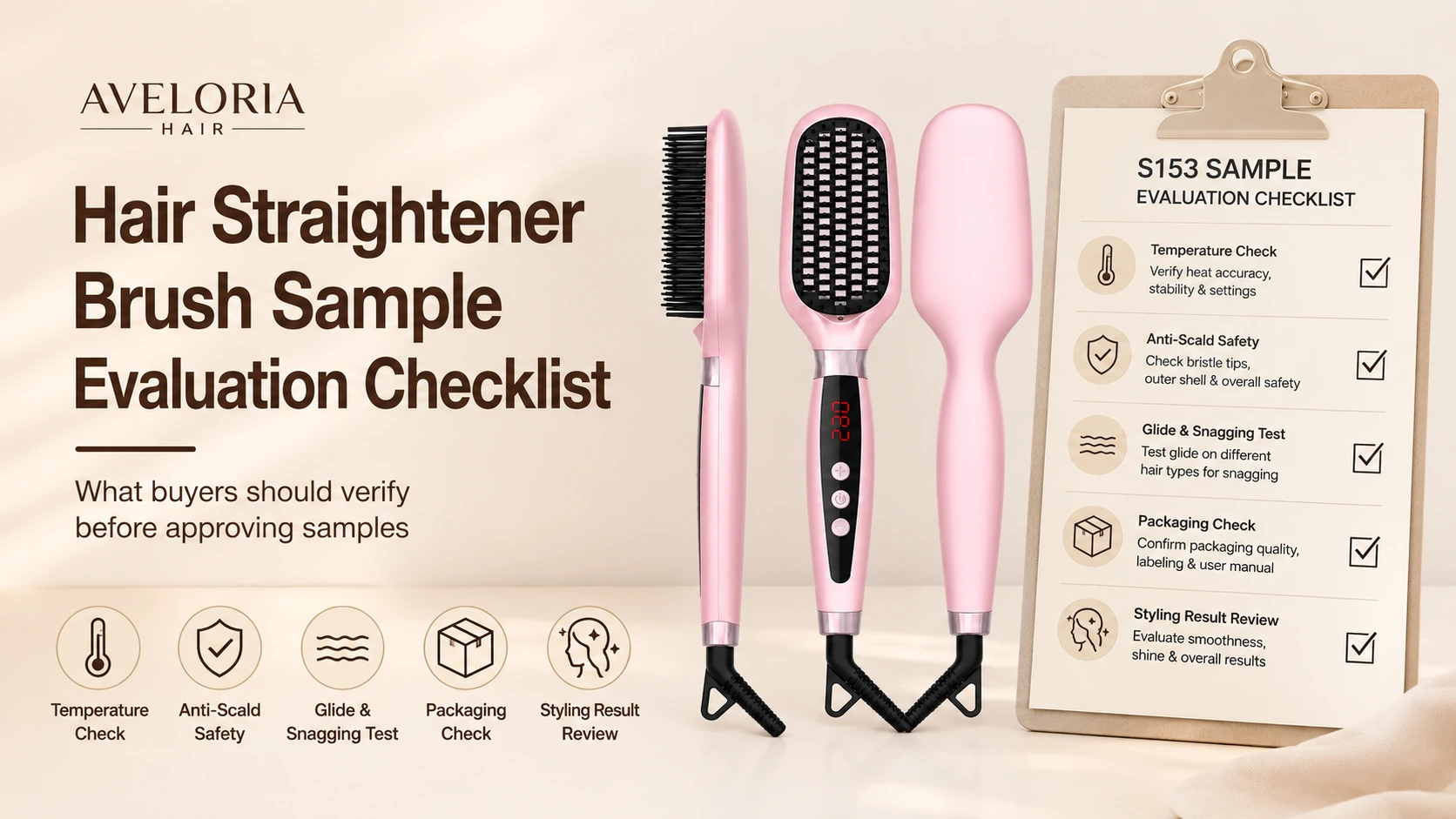
Why a Sample Evaluation Checklist Matters
Many buyers search for a hair straightener brush sample evaluation checklist after receiving a sample that feels “almost right” but not ready for approval. A useful checklist gives structure to that decision. Instead of reacting to random impressions, the buyer can review the product in the same order every time and document what needs to change.
This is especially important for new beauty brands, distributors and online sellers. Once mass production starts, fixing design issues, label mistakes or performance problems becomes slower and more expensive.
What the Sample Should Confirm
| Checklist Area | What to Verify |
|---|---|
| Appearance | Color consistency, surface finish, logo position, button fit and general workmanship. |
| Heating | Heat-up time, temperature accuracy, stability and whether the settings feel useful in real styling. |
| Anti-scald safety | Bristle-tip comfort, shell temperature, root access and how safe the brush feels near the scalp and ears. |
| Glide and snagging | Whether the brush pulls, catches or drags through different hair types. |
| Packaging | Box structure, artwork, manual content, barcode area and whether the retail presentation matches your brand. |
| Final result | Smoothness, frizz control, shine, finish consistency and whether the result matches the intended market positioning. |
How to Evaluate the Product Body
Start with the physical product before plugging it in. Check the housing seams, the feel of the buttons, the firmness of the cord entry and the alignment of any display or indicator lights. A good sample should feel production-ready, not like a loosely assembled mockup.
For the featured S153 Ionic Hair Straightener Brush, buyers can also review handle comfort, the size of the brush head and whether the overall format supports the target end user. A product that looks attractive online may still feel too bulky or too light in daily use.
Testing Temperature and Styling Performance
Do not rely only on a supplier statement such as “fast heating” or “stable temperature.” Measure the time required to reach a ready-to-style condition, then observe how the product behaves during continuous use. If possible, compare results on more than one hair type.
- Record the selected temperature setting.
- Measure time to ready-to-style use.
- Test whether the temperature remains consistent through several sections.
- Check whether the shell becomes uncomfortable to hold.
- Evaluate the finish after one pass and after repeated passes.
Glide, Snagging and Root Access
These points directly affect end-user reviews. A brush that drags through the hair may lead to complaints even if the heating system is technically correct. Test on smooth hair, frizz-prone hair and thicker sections if those hair types are part of the target market.
Root access also matters. Some buyers want a straighter finish closer to the roots, while others prioritize safety and a more natural result. The sample must match the brand promise.
Packaging and Private Label Review
The sample stage is also the best time to confirm box structure, insert fit, user manual language, warning labels and the feasibility of the logo process. If the goal is a private label hair straightener brush, the packaging should support that positioning instead of feeling like a generic re-label.
Ask whether the supplier can separate sample cost, product cost and packaging cost. This makes revisions easier to manage and avoids confusion later in the quotation process.
Recommended Approval Method
- Use a written sample checklist.
- Test the sample on real hair, not only by visual inspection.
- Photograph any defects, weak points or packaging issues.
- Mark each issue as “acceptable,” “needs revision” or “reject.”
- Approve only after both product and packaging are aligned.
Need a Structured Sample Review for Your Project?
Share your target market, preferred model and private label requirements. We can help you review the sample stage more systematically.
Frequently Asked Questions
What should a hair straightener brush sample checklist include?
At minimum, it should include appearance, heating performance, anti-scald safety, glide, snagging, packaging and final styling result.
Why is sample approval important for private label buyers?
It reduces the risk of approving a bulk order that later creates complaints, revisions or avoidable packaging mistakes.
Can I evaluate the sample from photos only?
Photos help, but they do not replace real testing of temperature, comfort, glide, snagging and packaging structure.
Which model is featured in this guide?
This guide features the S153 Ionic Hair Straightener Brush as an example sample-review model.
Continue your sourcing review
Use these related pages to compare models, assess samples and prepare a more complete supplier inquiry.
2026 Keyword & Buyer Intent Update
How should buyers evaluate a sample from a hair straightener brush manufacturer?
Evaluate the exact sample against a written project brief. Check model identity, appearance, logo, color, controls, heat-up behavior, temperature settings, anti-scald contact design, glide and snagging, cord or battery configuration, accessories, packaging, labels and instructions. Record every requested revision in writing so the next sample or pre-production approval can be compared against a controlled reference.
A hair straightener brush sample manufacturer should clarify what the sample represents: a standard catalog model, a branded sample, a functional prototype or a pre-production reference. Buyers should also use the sample stage to ask the same supplier questions about MOQ, production lead time, packaging, market configuration and quality inspection that will matter during bulk production.
Primary search intent: hair straightener brush sample manufacturer. Related buyer searches: questions to ask a hair straightener brush manufacturer, hair straightener brush quality inspection checklist, anti-scald hair straightener brush manufacturer.
Buyer FAQ
Should packaging be reviewed during the product sample stage?
If packaging is part of the project, yes. Even if the first sample uses temporary packaging, buyers should define artwork, insert, manual, label and barcode requirements early enough to avoid delaying production approval.
What happens if the sample needs changes?
List each change clearly, confirm which items require a revised sample and keep a version-controlled approval record before bulk production.