
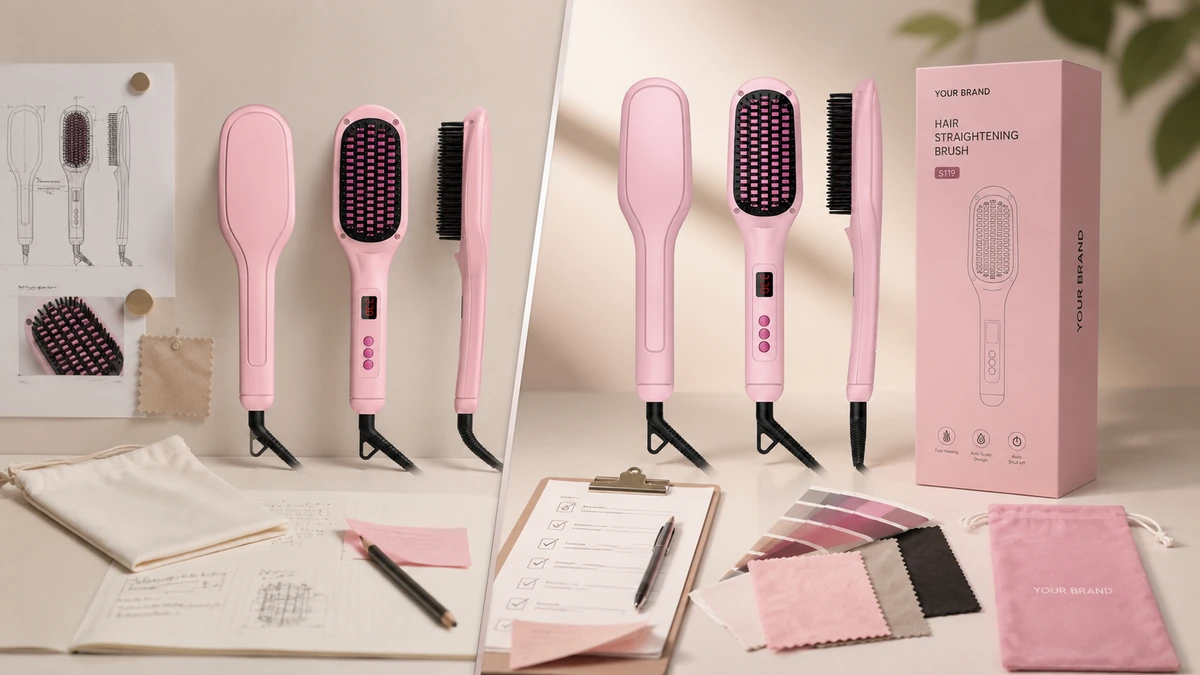
Why Buyers Need More Than One Type of Sample
Many buyers use the word hair straightener brush sample for every approval stage. That creates confusion. A factory stock sample, logo sample, color sample, packaging proof and pre-production sample solve different problems.
If these stages are not separated, a buyer may approve the function of a standard black product and later assume that the custom color, logo, plug, label and box are also approved. The supplier may interpret the approval differently. Clear sample terminology reduces this risk.
The Main Sample Types in a Private Label Project
| Sample Type | Main Purpose | What It Does Not Automatically Approve |
|---|---|---|
| Factory stock sample | Evaluate the existing model, heating, handling and styling result. | Final color, logo, market label, plug and packaging. |
| Functional sample | Verify a defined product configuration or technical change. | Retail presentation unless packaging is included. |
| Logo or color sample | Approve branding process, size, position and color direction. | All internal product and packaging details. |
| Packaging proof | Approve artwork, wording, barcode and print layout. | Finished box structure and complete production assembly unless physically sampled. |
| Pre-production sample | Confirm the complete final configuration before mass production. | Mass-production consistency; that still requires production controls and inspection. |
| Golden sample | Serve as the signed reference for production and final inspection. | Changes made after the reference was approved. |
What a Standard Product Sample Should Confirm
A standard sample is usually the most efficient first step. It allows the buyer to decide whether the product concept is suitable before paying for full private label development.
For example, the S119 Ionic Hair Straightener Brush can be evaluated as a model reference for brush shape, bristle arrangement, controls, temperature operation and user handling. The sample should be tested on the intended hair types, not only switched on for a few minutes.
- Appearance, dimensions and balance.
- Heat-up time and temperature settings.
- Temperature stability during use.
- Anti-scald comfort near scalp, ears and hands.
- Brush glide, snagging and hair tension.
- Button placement and accidental activation risk.
- Cord movement, strain relief or charging behavior.
- Final smoothness, frizz control and styling time.
What a Pre-Production Sample Should Confirm
The hair straightener brush pre-production sample should represent the product that will be manufactured. It is not just a better-looking sample. It is a control document in physical form.
| Approval Area | What the Buyer Should Check |
|---|---|
| Product model | Correct housing, heating system, temperature program, controls and included functions. |
| Color and finish | Approved color reference, gloss or matte level, part-to-part consistency and acceptable tolerance. |
| Logo | Position, size, color, process, adhesion and resistance to normal handling. |
| Market configuration | Voltage, frequency, plug, cord or charging accessory and user warnings. |
| Rating label | Model, electrical rating, manufacturer or responsible-party information and required symbols. |
| Manual | Language, operating steps, safety warnings, cleaning, storage and contact information. |
| Retail packaging | Artwork, color, product claims, barcode, insert, accessories and opening experience. |
| Shipping packaging | Units per carton, carton size, marks and protection during transport. |
Why a Normal Sample Often Has No Customer Logo
For many private label projects, the first sample uses an existing factory finish and standard box. This is practical because the buyer can evaluate product function before paying for printing plates, color matching or custom packaging.
Logo sampling can require a screen, plate, fixture, artwork preparation or minimum process batch. Packaging suppliers may also require a minimum quantity to produce a fully printed sample economically. Therefore, a functional sample without the buyer’s logo is not automatically a warning sign.
The important point is to document what the first sample does and does not represent. The quotation or sample confirmation should state whether the logo, color, plug, label, manual and packaging are standard or customized.
Approve Artwork Separately From Product Function
Artwork approval should use controlled files. Ask for a PDF proof or dieline showing:
- Final logo and brand spelling.
- Product name and model.
- Feature claims that match the approved product.
- Electrical rating and required warnings.
- Barcode number and quiet-zone placement.
- Manual version and languages.
- Country-of-origin and responsible-party information where applicable.
Do not approve important packaging text through a low-resolution chat screenshot. The final production file should have a version number or date.
Use a Written Sample Approval Record
A professional approval record should identify the sample, the date, the approved items and open issues. Use photographs of the exact sample and mark any accepted deviations.
If the buyer requests a change after approval, the supplier should confirm the effect on cost, lead time, documentation and sample status before production continues.
When the Pre-Production Sample Should Be Remade
- The heater, control board or temperature program changes.
- The housing material, color or surface process changes.
- The plug, cord, adaptor, battery or charger changes.
- The logo method or position changes materially.
- The rating label or manual contains important revisions.
- The box structure, insert or included accessories change.
- The existing sample cannot represent the final production method.
Minor text corrections may be approved through a controlled artwork proof, but the buyer should decide whether the change affects physical fit, safety communication or retail presentation.
How the Golden Sample Supports Final Inspection
The golden sample is the common reference for the buyer, supplier and inspection team. It should be identified clearly and stored carefully. The inspection checklist should refer to measurable criteria as well as visual comparison.
A golden sample alone is not enough for electrical or functional quality. The inspection plan should also state the number of units to test, the functions to check, acceptable appearance limits and the packaging requirements.
Recommended Approval Sequence
- Review catalogue and model specifications.
- Test a standard or functional product sample.
- Confirm target-market configuration.
- Approve logo and color direction.
- Approve packaging artwork and manual.
- Review the pre-production sample or final reference set.
- Issue written approval and freeze the specification.
- Use the approved reference during production and inspection.
Need to Plan Your Sample Approval Stages?
Share the selected model, target country, branding plan and packaging requirement. We can confirm which items can be reviewed on a standard sample and which should wait for the pre-production stage.
Frequently Asked Questions
What is the difference between a product sample and a pre-production sample?
A product sample usually confirms the basic model and function. A pre-production sample confirms the final production configuration, including color, logo, plug or charging accessory, labels, manual and packaging.
Does a standard sample need my logo?
Not necessarily. A standard sample can be used to evaluate function first. Logo and packaging can be approved later through artwork proofs, branding samples or a pre-production sample.
When should a pre-production sample be remade?
It should be remade when a material, color, internal component, plug, label, packaging structure or other approved item changes materially.
What is a golden sample?
A golden sample is the signed or clearly identified reference used by the buyer, supplier and inspector to judge whether mass production matches the approved standard.
Which model is featured in this guide?
The visual example features the S119 Ionic Hair Straightener Brush.
Continue your sourcing review
Use these related pages to compare models, assess samples and prepare a more complete supplier inquiry.
2026 Keyword & Buyer Intent Update
What is the difference between a hair straightener brush sample and a pre-production sample?
A development sample is used to evaluate the model, functions, appearance and customization direction. A pre-production sample is closer to the final mass-production specification and should reflect approved logo, color, packaging, labels, instructions and market configuration where applicable. Buyers should define which sample stage is being approved before counting production lead time.
Questions such as “how long does hair straightener brush production take” cannot be answered accurately without knowing whether artwork, packaging and pre-production approval are complete. An OEM hair straightener brush project with standard configuration may move faster than a project that still has unresolved color, electronics, packaging or compliance-document questions.
Primary search intent: hair straightener brush sample manufacturer. Related buyer searches: how long does hair straightener brush production take, OEM hair straightener brush, hair straightener brush contract manufacturer.
Buyer FAQ
Does production lead time start when the first sample is ordered?
Not necessarily. Production timing should be confirmed after the final specification, commercial terms and required approvals are complete.
When is a pre-production sample most useful?
It is useful when the buyer needs one controlled reference that reflects the final approved product and packaging before mass production starts.