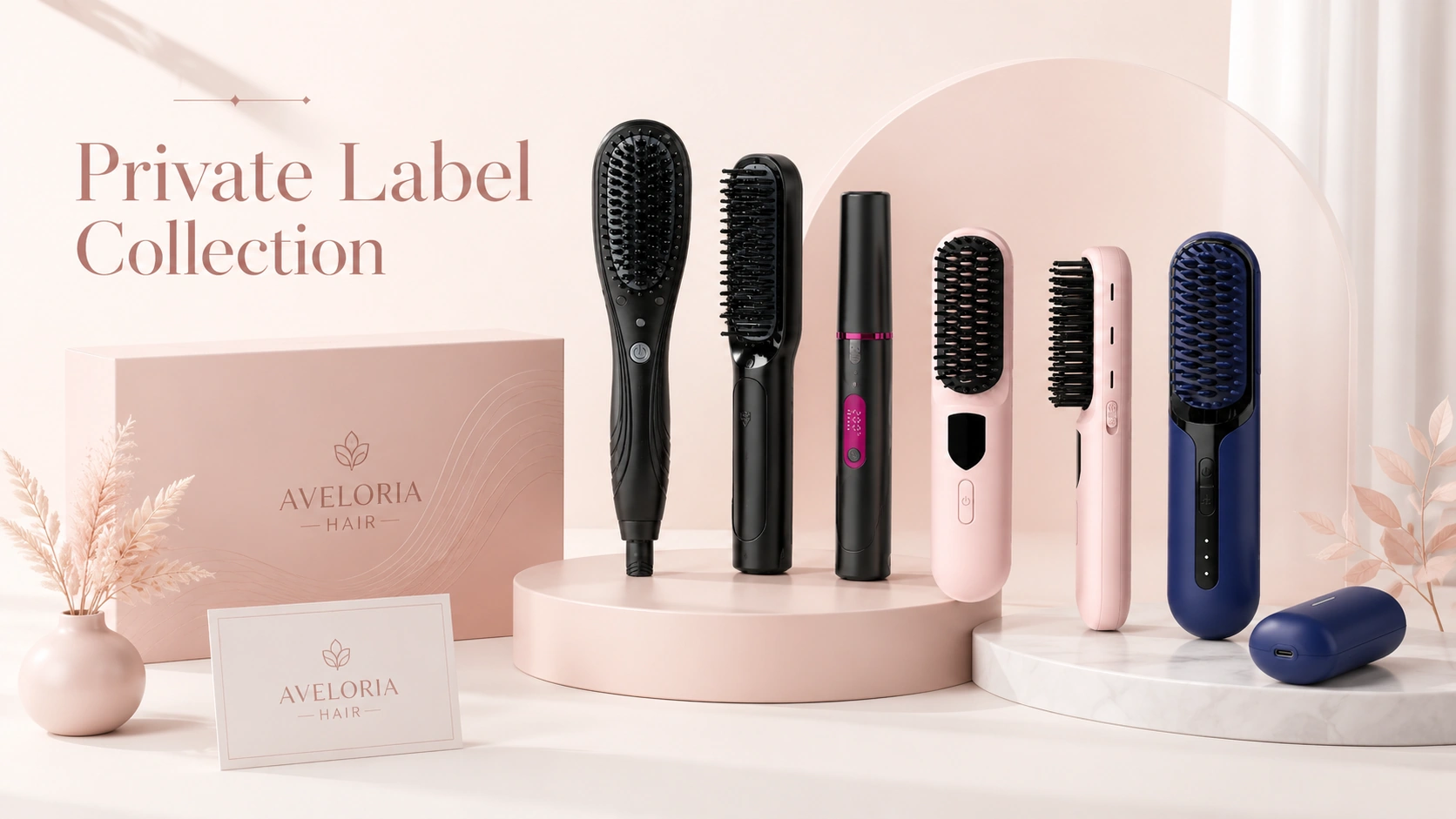
1. Start With a Focused Launch Range
A first private label hair tool collection does not need ten or fifteen similar products. For most new brand launches, a focused range of two to four clearly differentiated models is easier to explain, stock and promote.
A practical starting structure may include one core straightener brush, one upgraded feature model, one travel or rechargeable option and, only when the target channel supports it, one adjacent styling tool such as a flat iron.
Before selecting models, define the customer, target market, expected retail price and primary sales channel. A salon distributor, an online beauty brand and a mass-market retailer may require very different product combinations even when they sell under the same category name.
2. Give Every Model a Clear Role
Every SKU should answer a different buying need. If two products have nearly the same shape, temperature range, functions and retail price, customers may not understand why both are necessary.
| Product Role | Typical Purpose | Buyer Considerations |
|---|---|---|
| Entry model | Accessible price point and simple daily styling | Stable core functions, controlled packaging cost and clear instructions |
| Core model | Main sales volume and broad market suitability | Balanced feature set, recognizable design and reliable sample performance |
| Premium model | Higher-value positioning with stronger feature differentiation | Infrared, ionic, MCH or other verified functions that can be explained accurately |
| Travel model | Portable use, touch-ups and gifting | Charging method, battery requirements, working time, transport labels and compact packaging |
For a practical example of how two similar-looking models can serve different brand positions, review the S102 vs S102R model comparison.
3. Avoid Too Many Similar SKUs
Too many overlapping products create hidden costs. Each additional model may require separate samples, packaging artwork, manuals, barcodes, spare parts planning, product photography and inventory allocation.
Multiple colors can create the same problem. A brand may plan three colors for each of four models, but that quickly becomes twelve separate SKU combinations. If every variation has its own packaging and production requirement, the first order becomes more difficult to manage.
Keep a model only when it has a clear difference in function, target user, price level, design or use scenario. If the difference can only be explained by a minor cosmetic detail, it may be better to launch one stronger product first.
4. Match Products to Target Retail Prices and Sales Channels
Do not choose a product only because the factory unit price looks attractive. Start with the target retail price and work backward through distributor margin, platform fees, shipping, packaging, promotion and after-sales costs.
An entry-level marketplace product may need a simpler feature story and lower packaging cost. A salon brand or premium beauty retailer may require stronger differentiation, more detailed product education and more refined packaging.
- Online marketplaces: clear feature images, simple comparisons and strong review management are important.
- Beauty retailers: packaging hierarchy, shelf presentation, barcode planning and product education matter.
- Salon and distributor channels: specification sheets, market documentation and consistent repeat supply become more important.
- Gift and travel channels: compact size, storage, charging and presentation may influence the final choice.
A product should support the intended retail price without forcing the brand to make exaggerated claims.
5. Plan Straightener Brush, Rechargeable and Flat Iron Options Carefully
A hair tool collection does not need every styling format at launch. Straightener brushes can act as the hero category, while rechargeable models or flat irons are added only when they fill a specific gap.
A corded straightener brush is generally easier to position around regular home styling and stable power. A rechargeable model can support travel and touch-up use, but charging, battery transport and working-time information must be explained clearly.
A flat iron may suit customers who want a more traditional styling format or stronger precision around the roots and ends. For brands considering an adjacent flat iron option, the S185 Ionic Multifunctional Flat Iron can be reviewed as a separate product role rather than as another version of the same brush.
The collection should make it easy for buyers to understand which product is the everyday core model, which one is the premium upgrade and which one serves a different styling need.
6. Confirm Market, Plug and Compliance Requirements Before Final Selection
The same model may require different plug, voltage, labeling, manual and documentation arrangements depending on the destination market. These points should be confirmed before packaging artwork and bulk production.
- Target country or region
- Plug type and rated voltage
- Instruction manual language
- Warning labels and product markings
- Available test reports or compliance documents for the exact model
- Retailer, importer or marketplace documentation requirements
Do not assume that one certificate or one plug version automatically covers every market. Buyers planning UK or European sales can also review the UK and EU plug and documentation guide.
7. Control MOQ and Packaging Complexity
MOQ is affected by more than the product body. Custom colors, logo methods, printed boxes, manuals, inserts and carton marks can each introduce separate production thresholds.
For a first launch, it is usually more practical to use an existing product platform, confirm one main color and keep the packaging structure controlled. This reduces the risk of dividing the order across too many variations.
Before requesting a quotation, prepare the expected quantity, target market, preferred models, logo placement, packaging direction and launch schedule. The hair straightener brush MOQ guide explains the main factors that affect order thresholds.
8. Approve Samples Before Finalizing the Range
Catalogue images and specification sheets are not enough to finalize a product collection. Samples should be compared under the same review process so the brand can evaluate the real differences between models.
Important sample checks include:
- heat-up behavior and temperature control;
- brush glide, hair pulling and section contact;
- weight, grip comfort and button placement;
- anti-scald structure and housing temperature;
- corded or rechargeable user experience;
- logo position and surface finish;
- packaging size, protection and presentation;
- how accurately the final product can be described in retail content.
Use the hair straightener brush sample evaluation checklist to record the same criteria for every model before approving the launch range.
9. Launch Small, Then Expand With Sales Data
The first range should be treated as a controlled launch, not a permanent catalogue. After sales begin, review which model receives the most interest, which price level converts, which features customers understand and which products create returns or support questions.
Use real information from orders, customer feedback, retailer discussions and repeat inquiries to decide the second-stage expansion. A new color, rechargeable option or flat iron should be added because it answers a proven demand—not simply because another model is available.
A focused collection with clear product roles is easier to sell, easier to reorder and easier for customers to understand than a large catalogue of overlapping tools.
Conclusion
Building a private label hair tool collection requires product discipline. Start with a small number of differentiated models, match them to target retail prices and channels, confirm market requirements, control packaging complexity and approve samples before production.
The strongest launch range is not the one with the most products. It is the one where every model has a clear reason to exist and a clear customer to serve.
2026 Keyword & Buyer Intent Update
How should a beauty brand plan a collection with a private label hair styling tools manufacturer?
Start with one clear hero use case, then add supporting SKUs only when each model has a distinct customer, format or benefit. A private label hair styling tools manufacturer can help map existing product platforms, but the brand should control assortment logic, naming, packaging hierarchy and market positioning. Too many near-duplicate models can increase artwork, inventory and buyer confusion without adding meaningful choice.
A hair styling tools OEM manufacturer can support a broader range, but a new brand does not need to launch every available product. Beauty brands and salon brands should identify where straightener brushes, cordless models or other styling tools fit in the collection, then confirm MOQ and packaging consequences SKU by SKU.
Primary search intent: private label hair styling tools manufacturer. Related buyer searches: hair styling tools OEM manufacturer, hair straightener brush manufacturer for beauty brands, hair straightener brush manufacturer for salon brands.
Buyer FAQ
Should a new private label brand launch many straightener brush models at once?
Usually it is clearer to start with a focused assortment in which each SKU has a distinct role. The right number depends on channel, budget, MOQ and product strategy.
How should packaging stay consistent across multiple hair tools?
Use a shared brand system for color, typography, claims structure, barcodes, warnings and manuals while keeping model-specific specifications and required information accurate.
Continue your sourcing review
Continue your sourcing review
Use these related pages to compare models, assess samples and prepare a more complete supplier inquiry.