
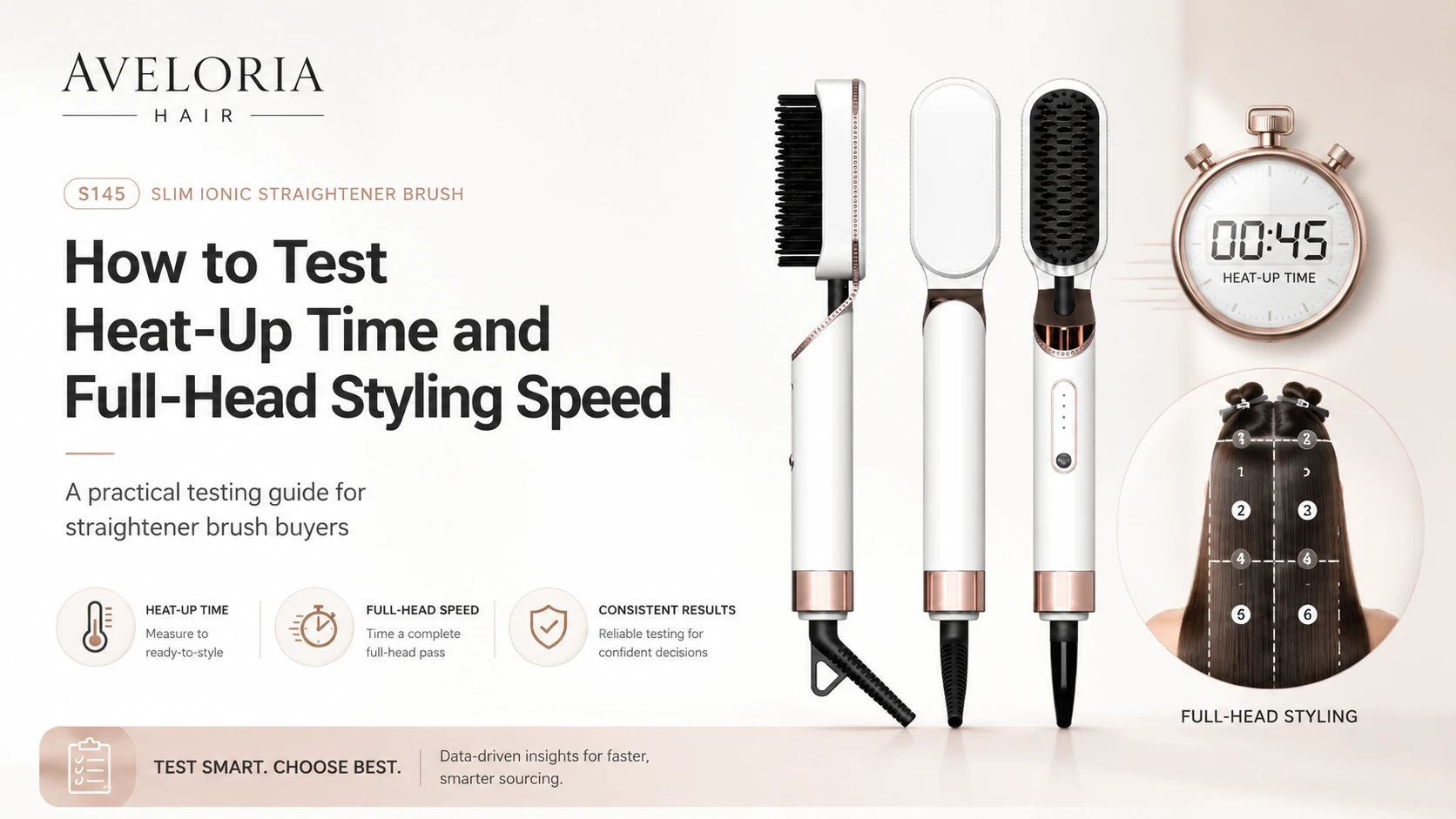
Why These Two Tests Matter
For a straightener brush performance test, the buyer should separate two key ideas: how fast the tool becomes ready to use, and how long it takes to complete a realistic full-head styling session.
Test 1: Heat-Up Time
Heat-up time should be measured from the moment the product is switched on to the moment it is genuinely ready for styling—not simply when a display lights up. Use the same temperature setting each time and repeat the test several times for consistency.
The S145 Slim Ionic Hair Straightener Brush is a useful model for this kind of performance review because buyers often evaluate it for convenient daily styling.
- Choose one temperature setting.
- Start timing when the product is switched on.
- Stop when the tool is ready for real styling use.
- Repeat the measurement several times.
- Record the average result.
Test 2: Full-Head Styling Speed
This test measures the real-world experience. Prepare a full head of hair, divide it into defined sections and time how long it takes to complete the style using the same routine.
| Testing Step | What to Control |
|---|---|
| Hair preparation | Use a consistent starting condition, such as dry and combed hair. |
| Sectioning | Divide the hair in the same way every time. |
| Temperature | Use the same setting for each test round. |
| Pass count | Use a consistent number of passes or a consistent styling standard. |
| End point | Define when the hair is considered “finished.” |
Why Buyers Often Confuse the Two
Some product pages emphasize a short heat-up time, but consumers care about the entire styling experience. If a tool warms up fast but needs too many passes or feels inefficient on larger sections, the final user may still feel it is slow.
How to Make the Test More Useful for Sourcing
Record the result with notes on hair type, section count and overall ease of use. This gives more value than a standalone timing number. For example, a model that is slightly slower on paper may still be easier to use and produce a better finish.
These notes are helpful when comparing models for a private label line. A buyer can decide whether to prioritize quick heat-up, faster full-head completion or a balance between speed and comfort.
Practical Recommendations
- Do not advertise “fast styling” without testing both metrics.
- Use the same tester and routine where possible.
- Compare more than one hair type if the target market is broad.
- Record both timing and styling-result notes.
- Use test results to support product selection and marketing claims.
Need Help Comparing Styling Performance?
Share your target market and product goals. We can suggest test points for heat-up, usability and styling performance.
Frequently Asked Questions
What is the difference between heat-up time and styling speed?
Heat-up time measures when the tool becomes ready for use, while styling speed measures how long it takes to complete a realistic styling session.
Why should buyers test both?
Because a product can warm up quickly but still feel slow in actual use if the styling process is inefficient.
How can the test be made more consistent?
Use the same hair preparation, sectioning method, temperature setting and end-point definition each time.
Which model is featured in this guide?
This guide features the S145 Slim Ionic Hair Straightener Brush as a testing example.
Continue your sourcing review
Use these related pages to compare models, assess samples and prepare a more complete supplier inquiry.
2026 Keyword & Buyer Intent Update
How should buyers test a fast heating hair straightener brush?
Use the same start temperature, power source, selected setting, timing method and sample condition for every comparison. Record time to a defined temperature or ready indicator, then separately measure real styling performance on a controlled hair section or test protocol. Heat-up speed alone does not determine styling speed; brush geometry, heat distribution, temperature stability and technique also matter.
When comparing an MCH fast heating straightening brush OEM option with a PTC hair straightener brush manufacturer option, test the actual samples rather than assuming one heater label guarantees a fixed outcome. For adjustable temperature, digital temperature or LCD models, also check display or control behavior, setting repeatability and the user experience of changing temperature.
Primary search intent: fast heating hair straightener brush manufacturer. Related buyer searches: MCH fast heating straightening brush OEM, MCH hair straightener brush manufacturer, PTC hair straightener brush manufacturer, adjustable temperature straightening brush OEM, digital temperature hair straightener brush, LCD hair straightener brush manufacturer.
Buyer FAQ
Is MCH always faster than PTC in every straightener brush?
Do not generalize from heater names alone. The complete product design, heater size, control system, target temperature and test method affect measured heat-up behavior.
Should heat-up time and full-head styling time be reported as the same metric?
No. Heat-up time measures how quickly the device reaches a defined state; styling time also depends on hair type, section size, brush design, temperature and technique.