
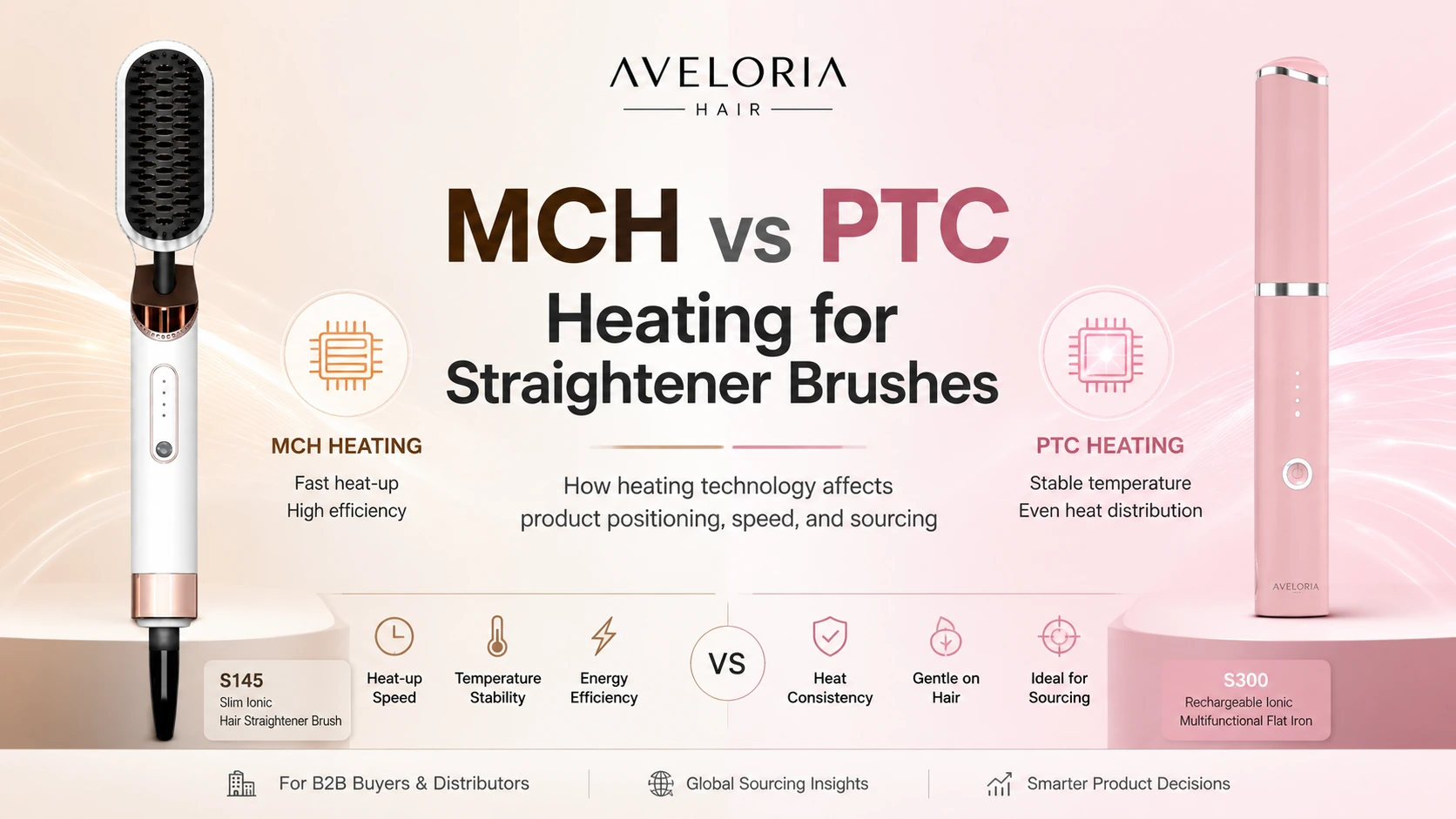
The Core Difference
Buyers frequently ask whether MCH vs PTC heating for straightener brushes should be treated as a quality ranking. It should not. The better question is: which heating system fits the intended product positioning, use scenario and sourcing goal?
What MCH Heating Usually Offers
MCH, commonly associated with metal ceramic heating, is often selected when a buyer wants a faster-heating or more premium-feeling product concept. It can support slim structures and a stronger “quick styling” story for marketing.
The featured S145 Slim Ionic Hair Straightener Brush is useful for this kind of discussion. Buyers evaluating a slim straightener-brush format often care about handling, styling speed and premium shelf appeal.
What PTC Heating Usually Offers
PTC heating is widely used where stability, practical control and reliable performance are important. In rechargeable or multifunctional tools, PTC can also align well with power-management needs, depending on the final structure.
The S203 Rechargeable Ionic Multifunctional Flat Iron represents a different direction. It combines a rechargeable concept with PTC ceramic heating and a more portable positioning.
MCH vs PTC: Buyer Comparison Table
| Factor | MCH Direction | PTC Direction |
|---|---|---|
| Heat-up story | Often supports a “fast styling” position. | Often supports a “stable performance” position. |
| Temperature behavior | Should be tested for consistency over repeated use. | Often valued for practical, stable control. |
| Product structure | Can suit slim, premium-looking formats. | Can support practical and rechargeable designs. |
| Marketing angle | Speed, sleekness and premium user feel. | Stability, consistency and daily convenience. |
| Sourcing decision | Useful where quick styling is a strong selling point. | Useful where reliability and broad usability matter most. |
How Buyers Should Test the Difference
- Measure time to ready-to-style use.
- Check heat stability during continuous use.
- Compare results on more than one hair type.
- Observe shell comfort and handling.
- Review whether the heating story supports the retail price position.
A heating comparison should be tied to the brand concept. A faster or more premium-feeling technology only matters if it supports a marketable difference for the target customer.
When to Choose MCH First
Start with MCH if the brand wants a slim ionic straightener brush, a more premium look or a product story built around speed and fast styling convenience. The sample stage should confirm whether the real experience supports those claims.
When to Choose PTC First
Start with PTC if the project focuses on practical use, stable heating or a rechargeable format. For portable tools, power behavior and user expectations can be just as important as styling speed.
Comparing Heating Technologies for Your Product Line?
Tell us your target market, price level and product concept. We can suggest MCH or PTC directions for review and sampling.
Frequently Asked Questions
Is MCH always better than PTC?
No. MCH and PTC serve different product goals, and the better option depends on heat-up needs, structure, positioning and sourcing priorities.
Which heating system is better for rechargeable tools?
That depends on the full design, but PTC is often considered for practical and rechargeable product structures.
Should buyers choose based only on heat-up speed?
No. Heat stability, handling, product positioning and sample performance should also be evaluated.
Which models are featured in this guide?
This guide uses the S145 straightener brush and the S203 rechargeable multifunctional flat iron as reference examples.
Continue your sourcing review
Use these related pages to compare models, assess samples and prepare a more complete supplier inquiry.
2026 Keyword & Buyer Intent Update
MCH vs PTC hair straightener brush: which heating system should a private label brand choose?
Choose from the performance of the complete product, not the heater acronym alone. MCH and PTC can be implemented in different brush structures and control systems, so buyers should compare heat-up time, temperature stability, surface temperatures, control behavior, user experience, cost and sample results on the exact models being considered.
An MCH hair straightener brush manufacturer may position fast heating as a benefit, while a PTC hair straightener brush manufacturer may offer different ceramic or temperature-control configurations. Use one repeatable test method and compare the full product specification before deciding which platform fits the brand.
Primary search intent: MCH vs PTC hair straightener brush. Related buyer searches: MCH hair straightener brush manufacturer, MCH fast heating straightening brush OEM, PTC hair straightener brush manufacturer, PTC ceramic straightening brush supplier.
Buyer FAQ
Does MCH always heat faster than PTC?
Not in every product. Heater type is only one part of the design. Power, control logic, heater geometry, target temperature and test method affect measured results.
Can a PTC straightener brush also use ceramic components?
Yes, depending on the product design. PTC refers to heating technology, while ceramic may describe a surface, coating or component. Confirm the exact model construction.