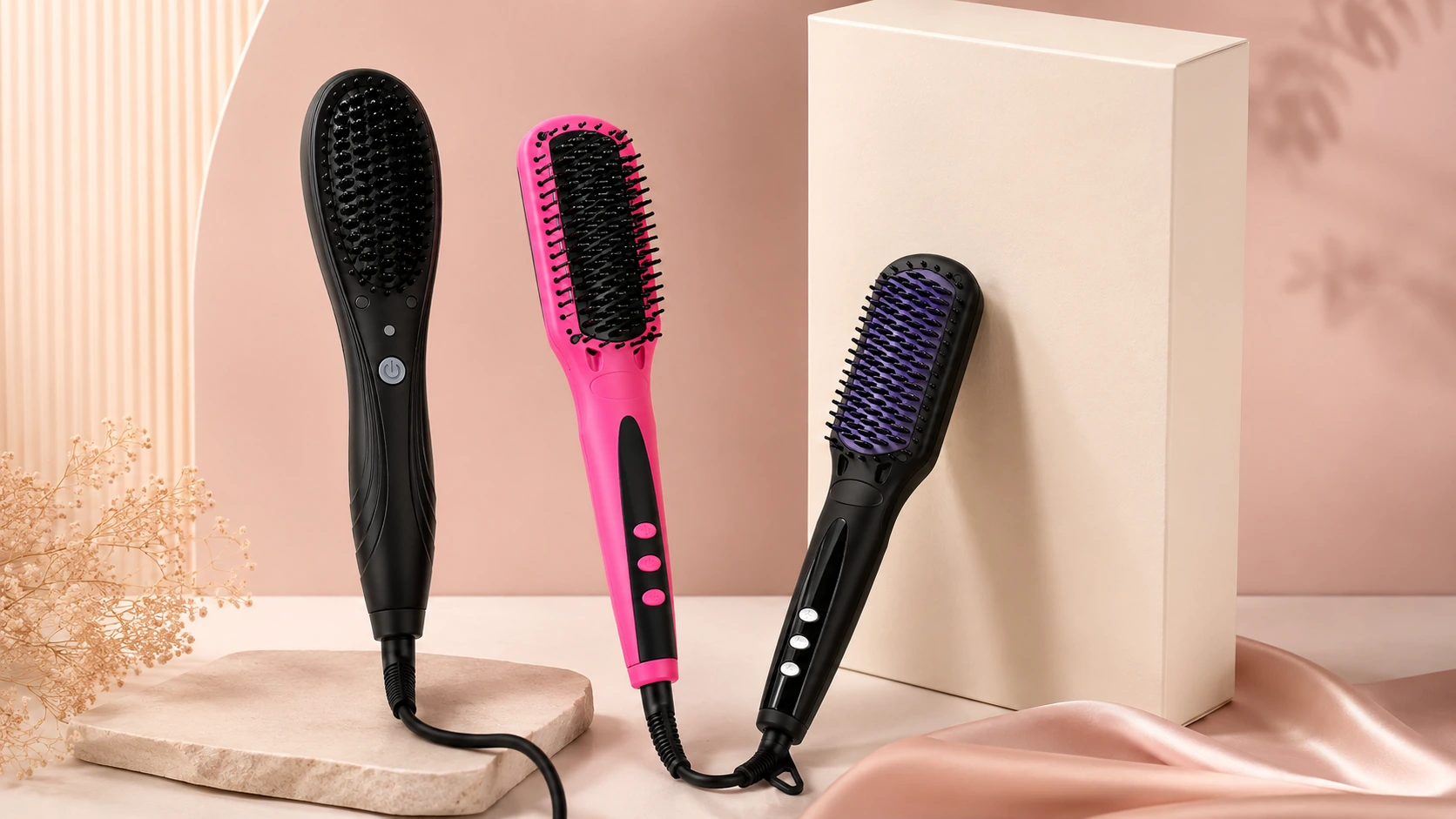
Product planning focus: private label hair straightener brushes, OEM/ODM hair styling tools, custom packaging, plug planning and selected-model document discussion.
Why straightener brush positioning matters for B2B buyers
Most end consumers care about smoother styling, easier daily use, safer heat contact, compact storage and a tool that feels simpler than a flat iron. A beauty brand or distributor should translate those needs into product positioning and model selection.
For B2B sourcing, the stronger project requirements are more specific: private label manufacturing, OEM ionic models, wholesale hair straightening brushes with custom packaging, UK plug planning and selected-model document review. These details indicate a buyer who is closer to product development or wholesale purchasing.
Start with market version: US, UK or EU
Before selecting color, packaging or logo position, confirm the target country or region version. A US program may require 110–120V planning and US plug discussion. UK and EU programs usually require different plug and labeling planning, and buyers may also ask about CE, UKCA or test documentation depending on distribution channel.
For EU planning, Aveloria recommends buyers review official CE marking responsibilities on the European Commission website and discuss final compliance requirements with their own importer or test partner. For Great Britain, the GOV.UK product marking guide is a useful external reference for UKCA and CE market placement planning.
- External reference: European Commission CE marking guidance.
- External reference: GOV.UK UKCA and CE product marking guidance.
Choose a product positioning before choosing a model
A brand selling to salons, Amazon sellers, boutique retailers or TikTok beauty buyers may need different product positioning. For example, a compact ceramic straightener brush can work as an entry-level daily styling product, while an infrared ionic hair straightener brush can support a more premium positioning.
For a product range, consider one hero model and two supporting models. A balanced collection may include an ionic straightener brush for daily use, a ceramic straightener brush for value positioning and a rechargeable hair straightener brush for travel-friendly content.
- Daily-use model: S102 Ionic Hair Straightener Brush.
- Ceramic heating model: S105 Ceramic Hair Straightener Brush.
- Premium infrared option: S102R Infrared Ionic Hair Straightener Brush.
Packaging and private label details buyers should prepare
Private label packaging should be planned early because it affects quote accuracy, sample cost and lead time. Buyers should prepare logo files, brand color references, preferred box size direction, instruction manual language, barcode or label needs, and whether the order needs a gift-box presentation or a simpler wholesale packaging plan.
A common mistake is asking for a quote before confirming packaging scope. A printed color box, custom manual, logo on product body and outer carton label do not have the same cost or MOQ impact. Tell the supplier which parts must be branded and which parts can remain standard.
Supplier questions before sample approval
Ask for the temperature range, heating system, plug version, cord or charging structure, product size, packaging options, sample fee, sample lead time, MOQ from 1,000 pcs per model and customization details and mass production lead time. For EU and UK projects, request available compliance documents early so your local importer can review them before final order planning.
The goal is not only to find a nice product picture. The goal is to build a product offer, packaging plan and wholesale presentation that your customers can understand quickly.
Frequently asked questions
What should a private label hair straightener brush project prepare?
Prepare the target country or region, product positioning, preferred model type, plug version, quantity range, logo file, packaging needs and any documentation expectations.
Should a US brand choose cordless or corded models first?
A US brand should choose based on retail positioning. Corded models are usually easier for daily home styling, while rechargeable models are stronger for travel, handbag and quick touch-up content.
What should I prepare before requesting a quote?
Prepare target country or region, plug type, quantity range, logo file, packaging requirement, preferred product model, certification expectations and whether you need sample support.
2026 Keyword & Buyer Intent Update
What changes when sourcing a private label hair straightener brush for Europe versus the USA?
The base product may be similar, but market configuration can change plug or charging arrangement, voltage, packaging language, labels, instructions and the document set that must be reviewed. Buyers should define the destination country before approving a sample and verify all model-specific requirements rather than asking for a generic “EU” or “US” version after production planning has started.
Searches for an EU plug hair straightener brush manufacturer, US plug hair straightener brush manufacturer, 110V or 220V manufacturer reflect practical buyer needs, but those terms must map to the actual model. Confirm voltage range, plug, power rating, labels and documents on the exact SKU. For US distributors or European brands, packaging and importer or responsible-party information may also require market-specific review.
Primary search intent: private label hair straightener brush Europe. Related buyer searches: private label straightening brush USA, EU plug hair straightener brush manufacturer, US plug hair straightener brush manufacturer, hair straightener brush supplier for European brands, hair straightener brush supplier for US brands, wholesale hair straightener brush for US distributors, 110V hair straightener brush manufacturer, 220V hair straightener brush manufacturer, dual voltage straightening brush manufacturer.
Buyer FAQ
Can one straightener brush use the same plug and packaging for UK, EU and US markets?
Usually buyers should expect market-specific review. Plug, voltage, packaging language, labels, manuals and regulatory responsibilities can differ by destination.
Does “dual voltage” mean no other market changes are needed?
No. Even if a model supports a wider voltage range, plug, labeling, packaging, instructions and applicable documents still need to be reviewed for the target market.
Continue your sourcing review
Continue your sourcing review
Use these related pages to compare models, assess samples and prepare a more complete supplier inquiry.