
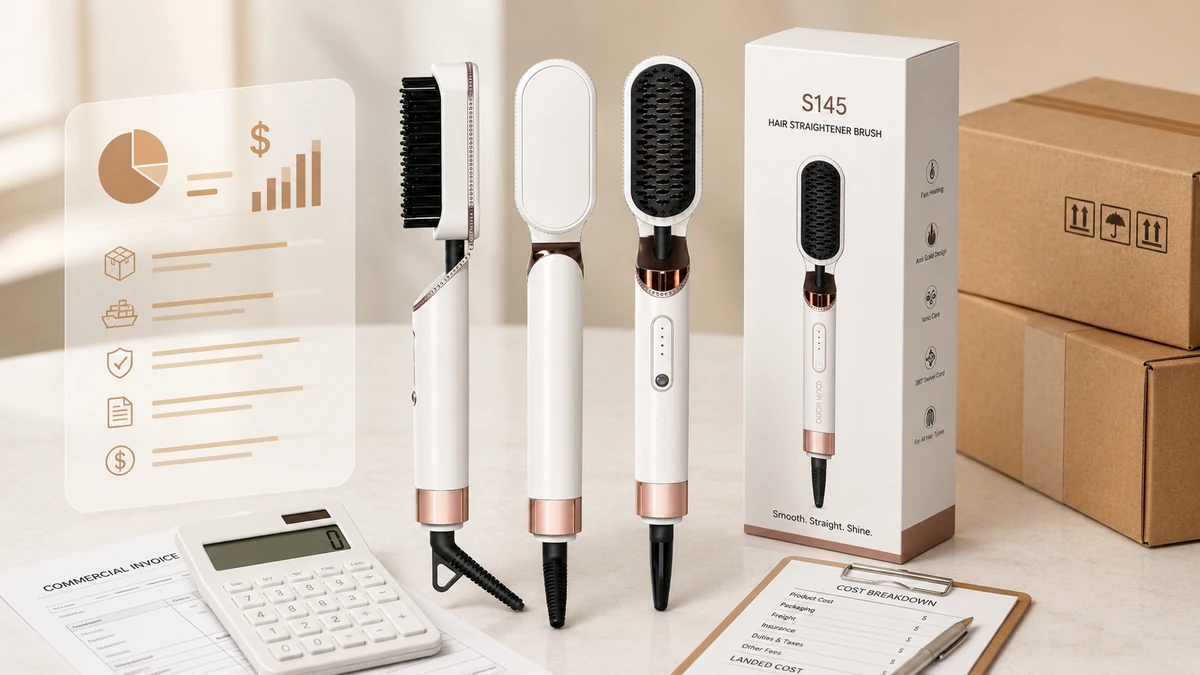
Factory Price Is Not the Same as Landed Cost
A buyer searching for private label hair straightener brush cost often starts with the unit price. That is understandable, but it can lead to the wrong decision. The final cost also depends on branding, packaging, accessories, freight, import charges, customs handling, local delivery and quality loss.
A product quoted at a lower factory price may use a larger box, require more expensive shipping, include fewer accessories or create a higher defect and return risk. A more complete quotation may look higher at first but produce a lower and more predictable landed cost.
A Practical Landed-Cost Formula
Landed cost per saleable unit = (product + customization + packaging + sampling allocation + export and freight + insurance + duty and import tax + clearance and local delivery + quality allowance) ÷ expected saleable units.
The denominator matters. If you order 1,000 units but expect only 980 units to be saleable after testing, transit damage and warranty allocation, calculate the cost over 980—not 1,000.
1. Base Product Cost
The base product cost should reference the exact model and configuration. For example, the S145 Slim Ionic Hair Straightener Brush may be evaluated for its format, temperature range and private label positioning, but the final quotation still depends on the approved product version, quantity and customization.
Ask whether the quoted price includes the plug, cord, pouch, comb, heat-resistant accessory, charging cable, adaptor, manual, inner tray and retail box. A short product description can hide important exclusions.
2. Logo, Color and Product Customization
| Customization Area | Possible Cost Effect |
|---|---|
| Logo | Printing plate, screen printing, pad printing, laser marking or other process setup. |
| Color | Color matching, material preparation, minimum batch requirement and approval samples. |
| Controls and labels | Button symbols, display layout, rating label, warning label and barcode. |
| Accessories | Pouch, glove, clip, comb, adaptor, cable or additional inserts. |
| Product changes | Structural modification, electronic change, mold work, engineering and additional verification. |
Separate one-time setup costs from recurring per-unit costs. A printing plate or artwork proof may be charged once, while a customized accessory adds cost to every unit.
3. Retail Packaging and Documentation
Packaging cost includes more than the printed box. Buyers may also need an inner tray, protective bag, instruction manual, warning card, product label, barcode, shipping marks and master-carton specifications.
Packaging size affects freight. A visually impressive box that is 20% larger can increase carton volume and shipping cost significantly, especially for air freight and courier delivery. Ask the supplier for:
- Unit box size and gross weight.
- Units per master carton.
- Master-carton dimensions and gross weight.
- Packaging material and insert structure.
- Estimated chargeable weight for the planned shipment.
4. Samples, Artwork and Pre-Production Approval
Sample fees, courier charges, color samples, logo tests, packaging proofs and pre-production samples are project costs. They may not be part of the factory unit price, but they should be included in the first-order budget.
A simple method is to allocate all launch-development costs across the first production run. If the project uses several sample rounds, divide those costs across the expected saleable quantity so the retail margin is not overstated.
5. China-Side Logistics and Export Costs
Depending on the trade term, the quotation may or may not include factory pickup, domestic transport, export handling, customs declaration, documentation and delivery to the port or freight terminal.
Ask the supplier or forwarder to state the named place and included services. “FOB China” is incomplete without a port. “Shipping included” is incomplete without the destination, service level and list of excluded charges.
6. International Freight and Insurance
Air, courier, rail and sea freight have different cost and timing structures. The best option depends on shipment size, launch urgency, battery status, carton volume and destination.
| Shipping Method | Typical Planning Use | Cost Risk to Check |
|---|---|---|
| Courier | Samples and very small urgent shipments. | Remote-area fees, customs brokerage and destination tax collection. |
| Air freight | Time-sensitive commercial orders. | Chargeable weight, handling and airport-to-warehouse delivery. |
| Sea freight | Larger, less urgent orders. | Minimum charges, port fees, customs, storage and local delivery. |
| Rail or multimodal | Selected routes where time and cost fall between air and sea. | Route-specific handover, customs and final-mile fees. |
Insurance should be confirmed separately. A freight quotation that excludes cargo insurance leaves the buyer exposed if the shipment is lost or damaged.
7. Customs Value, Duty and Import Tax
The importer should verify the correct commodity classification and customs-value method. Customs value can include more than the factory invoice. For example, official UK guidance explains that certain freight, insurance, loading and handling costs up to the point of entry can form part of customs value.
Duty and import tax vary by destination, classification and current rules. Do not copy a rate from another buyer’s shipment. Check the official tariff service for the destination market and obtain broker confirmation for the exact product.
8. Customs Clearance and Local Delivery
Destination charges may include brokerage, document fees, terminal handling, port or airport charges, examination fees, storage, duty-advancement fees and delivery to the warehouse. These costs are often missing from a simple freight quotation.
Ask the forwarder for a written destination-cost estimate and clarify who is the importer of record. Under DAP, duties and taxes are normally not included. Under DDP, the seller may quote a more inclusive service, but the commercial and compliance responsibilities still need to be reviewed carefully.
9. Quality, Returns and Warranty Allowance
A realistic landed-cost model includes an allowance for inspection failures, transit damage, customer returns and warranty support. The percentage depends on the product, supplier history, packaging and market channel.
Quality cost should not be treated only as a loss. Spending on sample testing, pre-shipment inspection and stronger packaging may reduce a much larger return and reputation cost later.
Illustrative Cost Worksheet
The table below is a planning structure, not an Aveloria quotation and not a tax calculation.
| Cost Category | Illustrative Project Amount | Buyer Action |
|---|---|---|
| Product and accessories | Enter supplier quotation | Confirm exact model and included items. |
| Logo and color | Enter setup + per-unit cost | Separate one-time and recurring charges. |
| Packaging and manuals | Enter box, insert and print cost | Confirm dimensions and carton packing. |
| Samples and development | Allocate across first order | Include courier and proofing rounds. |
| Freight and insurance | Use written forwarder quote | Check chargeable weight and destination. |
| Duty and import tax | Use official rate and customs value | Verify classification with broker. |
| Clearance and local delivery | Use destination estimate | Include terminal and brokerage fees. |
| Quality allowance | Set project-specific percentage | Base on testing, packaging and channel. |
How MOQ Changes the Cost Per Unit
A higher quantity can reduce some per-unit costs because setup, artwork and shipping are shared across more units. However, ordering more does not automatically improve profitability. Inventory financing, storage, slow sales and product revisions also have a cost.
For a private label project, compare at least three scenarios: the minimum feasible order, the expected launch quantity and the quantity required for the best packaging or color option. Use the same landed-cost formula for each scenario.
Questions to Ask Before Comparing Quotations
- Does the price include the selected plug, cord or charging accessory?
- Is the packaging standard or fully customized?
- Are logo setup, manual and label costs included?
- What are the unit and carton dimensions?
- Which trade term and named location apply?
- Are inspection, testing or document costs separate?
- What quantity tolerance applies to production?
- Which destination costs are excluded?
Need a Costed Product and Packaging Direction?
Send the selected model, target quantity, destination market, plug requirement and packaging plan. We can separate the product, customization and packaging assumptions so you can build a more accurate landed-cost worksheet.
Frequently Asked Questions
What is included in the landed cost of a hair straightener brush?
It normally includes the product, customization, packaging, freight, insurance, duty, import tax, customs clearance, local delivery and an allowance for unsaleable units.
Is the lowest factory price always the lowest landed cost?
No. Packaging volume, shipment method, quality level, defect risk, trade term and destination charges can make a lower factory price more expensive after import.
Should sample fees be included in landed cost?
For launch planning, buyers should allocate sampling, artwork, packaging proofs and testing costs across the expected first production volume.
How do I find the correct duty rate?
Confirm the commodity code and destination tariff using the official customs tariff service or a qualified customs broker.
Which product is featured in the cost-planning image?
The visual features the S145 Slim Ionic Hair Straightener Brush as a private label cost-planning example.
Continue your sourcing review
Use these related pages to compare models, assess samples and prepare a more complete supplier inquiry.
2026 Keyword & Buyer Intent Update
How should buyers compare hair straightener brush factory price with landed cost?
Factory price is only one line in the landed-cost model. Buyers should add branding, custom color, packaging, accessories, inspection, freight, duty, tax, customs clearance, local delivery and a quality or contingency allowance where appropriate. Compare suppliers using the same product specification, quantity, packaging and trade term so the apparent unit-price difference is not caused by missing cost items.
A hair straightener brush wholesale price can look attractive at a larger bulk order, but freight volume, printed packaging, destination charges and inventory carrying cost can offset part of the unit saving. Ask a bulk hair straightener brush supplier for packing details once the configuration is stable so logistics estimates are based on realistic carton information.
Primary search intent: hair straightener brush factory price. Related buyer searches: hair straightener brush wholesale price, hair straightener brush bulk order, bulk hair straightener brush supplier, factory direct hair straightener brush wholesale.
Buyer FAQ
Is EXW or FOB price the same as landed cost?
No. EXW and FOB describe points in the trade and logistics chain. Landed cost includes additional freight, import and local-delivery items that depend on destination and the buyer’s arrangements.
Why should buyers use the same trade term when comparing suppliers?
Different trade terms include different cost responsibilities. Comparing unlike terms can make one quote appear cheaper even when the total cost is not lower.