
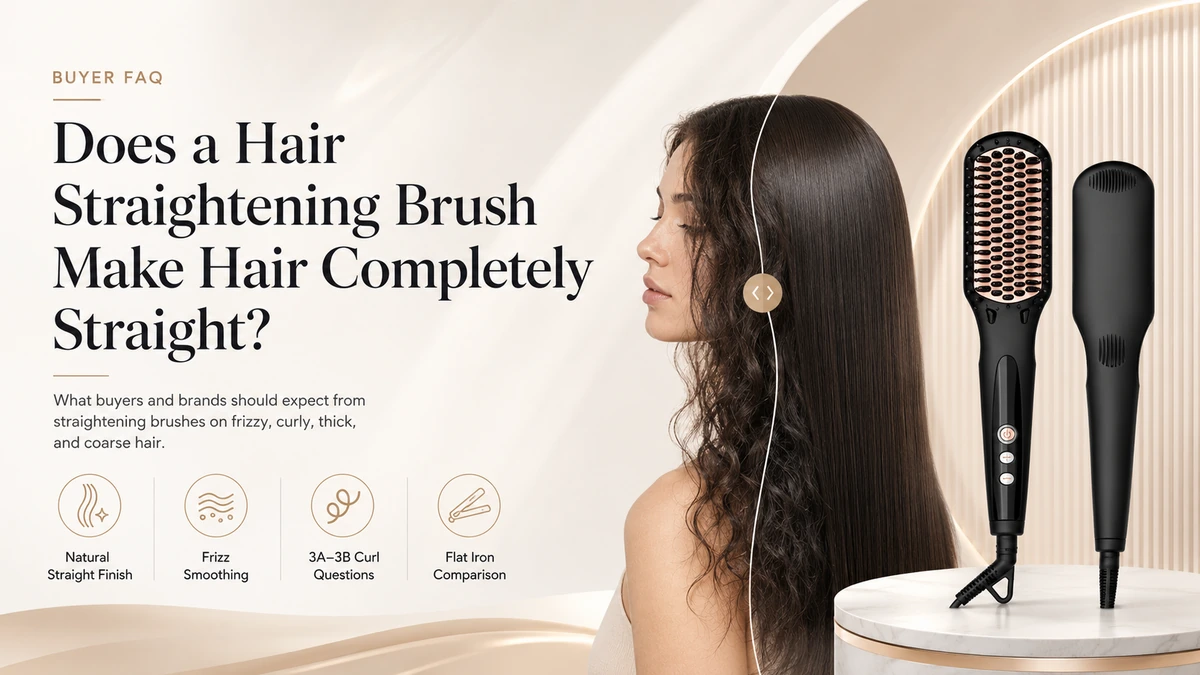
The Direct Answer: Straighter, Smoother Hair—Usually Not Flat-Iron “Pin Straight”
The question “does a hair straightening brush make hair completely straight?” has no single answer for every user. Performance depends on the starting hair pattern, strand thickness, density, moisture level, section size, heat setting, brush design, technique and even humidity after styling.
For many customers, this is not a weakness. A straightening brush often leaves more movement and root volume than a flat iron. The result can look softer and more natural, which is why many users choose it for everyday styling rather than for an ultra-flat salon finish.
Can It Create the Same “Bone Straight” or Scalp-Flat Effect as a Flat Iron?
Usually, not in exactly the same way. A flat iron clamps the hair between two heated plates. That combination of direct contact, pressure and tension can flatten the strand very efficiently. A hair straightening brush heats and aligns the hair while the bristles guide it, but it does not normally compress every strand between two solid plates.
As a result, a straightening brush commonly produces:
- less frizz and fewer flyaways;
- less puffiness and better shape control;
- a smoother surface and more polished appearance;
- a natural straight finish with movement;
- more volume at the roots than a flat iron usually leaves.
Users who specifically want very flat roots, sharply straight ends or a “silk press” style finish may still prefer a flat iron, or use one only on the areas that need extra precision.
Hair Straightening Brush vs Flat Iron: What Result Should Customers Expect?
| Styling Goal | Hair Straightening Brush | Flat Iron |
|---|---|---|
| Reduce frizz and puffiness | Very suitable for daily smoothing | Also effective, with a flatter finish |
| Natural blowout-style straight hair | Usually the stronger fit | May look flatter or more pressed |
| Keep some root volume | Generally easier | Can flatten the root area |
| Bone-straight or pin-straight finish | Possible on some hair, but not consistent across all textures | Usually more suitable |
| Quick everyday touch-up | Convenient for many users | More precise but often requires smaller sections |
| Very resistant curls or coarse sections | May need repeated passes and careful sectioning | Often provides stronger pressing action |
This is the practical difference behind many searches for hair straightening brush vs flat iron. The brush is often chosen for speed, ease and a softer finish; the flat iron is chosen for maximum compression and precision.
Does a Hair Straightening Brush Work on Natural Curls, 3A Hair or 3B Hair?
A hair straightening brush for curly hair can be effective, but “effective” should be defined correctly. On natural curls, the brush can stretch the curl pattern, smooth the surface, reduce frizz and produce a looser, straighter finish. It should not be assumed that every curl type will become completely bone straight with one pass.
Results on 3A Curls
For 3A curls, a suitable heated straightening brush may create a smooth, elongated result that resembles a blowout. Some users may achieve a nearly straight finish after careful sectioning and repeated passes, especially when the hair is fully dry and easy to tension.
Results on 3B Curls
For 3B curls, the brush can still reduce volume, loosen the curl and improve smoothness, but the hair usually needs smaller sections, slower passes and stronger tension. The roots or more resistant areas may retain texture. Customers wanting an ultra-straight finish may use a flat iron afterward on selected sections.
Therefore, a product advertised as a hair straightening brush for 3A and 3B curls should be tested honestly on those textures. The brand should show realistic before-and-after results instead of suggesting that all curl types will become identical after one pass.
Can Thick, Coarse or Frizzy Hair Be Straightened in One Pass?
For dense, coarse or very frizzy hair, one-pass claims are rarely realistic for every customer. A hair straightening brush for thick coarse frizzy hair performs best when the brush can contact the full section evenly and the user can maintain enough tension while moving the tool through the hair.
Several factors affect the number of passes:
- Section thickness: large sections reduce contact between the heated area and inner strands.
- Hair density: dense hair generally requires more sections and more total styling time.
- Strand texture: coarse strands may need a slower pass or a higher suitable setting than fine hair.
- Brush-head design: bristle spacing, heated area and anti-scald structure influence how well the hair reaches the heat.
- Temperature stability: a displayed setting is only useful when the brush maintains consistent performance.
- Technique: tension and brush direction can make a large difference.
A more credible product message is “smooths and straightens with controlled sectioning” rather than “straightens every hair type in one pass.”
Do You Still Need a Flat Iron After Using a Straightening Brush?
Not always. Many users will be satisfied with the brush alone when the goal is smooth, manageable and naturally straight-looking hair. A second tool is more likely to be used when the customer wants:
- extra-flat roots;
- very straight ends;
- more control around the hairline;
- a uniform pin-straight finish;
- additional work on resistant coarse or curly sections.
For this reason, the answer to “do you need a flat iron after a straightening brush?” depends on the desired look—not simply whether the brush works. For a soft daily finish, often no. For a highly pressed finish, sometimes yes.
What a Hair Straightening Brush Usually Does Best
Across the most common customer expectations, straightening brushes are better positioned around four practical benefits:
1. Smoothing Frizz
The brush helps align the hair while applying controlled heat, which can make the surface look smoother and less fuzzy. Ionic models may also be marketed around static and frizz control, provided the claim matches the actual product specification.
2. Reducing Puffiness and Uncontrolled Volume
Curly, wavy or coarse hair can look more compact and controlled after brushing, even when some natural body remains.
3. Making Hair Feel and Look Sleeker
The styling action can create a neater appearance with more movement than a heavily pressed flat-iron finish.
4. Creating a Natural Blowout-Style Straight Finish
This is often the most accurate description: smoother, straighter hair with some softness and root lift, rather than hair that looks completely flat against the scalp.
How to Get Better Results from a Hair Straightening Brush
Users should always follow the instructions for the selected model. In general, results are easier to evaluate when the hair is fully dry, detangled and divided into manageable sections.
- Use smaller sections on thick, coarse or curly hair.
- Keep controlled tension on the section while brushing.
- Move slowly enough for the heated area to contact the hair.
- Brush the top and underside of resistant sections where appropriate.
- Choose a heat level suitable for the hair type and the product instructions.
- Allow realistic time for dense hair rather than expecting one fast pass.
- Evaluate the finish in normal humidity, not only immediately after styling.
Technique can improve the result, but it cannot turn every brush into a flat iron. Product design and honest positioning still matter.
What Beauty Brands and Wholesale Buyers Should Test Before Sourcing
For brands searching for a private label hair straightening brush, a wholesale ionic hair straightener brush or an OEM hair straightening brush supplier in China, the sample evaluation should go beyond heat-up time and appearance.
A structured sample evaluation checklist for hair straightener brushes helps buyers document performance across target hair types before approving bulk production.
| Test Area | Questions for the Buyer or Seller |
|---|---|
| Target hair types | Is the product intended for straight, wavy, 3A, 3B, thick, fine or coarse hair? |
| Real styling outcome | Does it create natural straightness, frizz reduction or a genuinely flat finish? |
| Number of passes | How many passes are normally required on each test hair type? |
| Root access | Can the brush work near the roots while maintaining an anti-scald design? |
| Heat consistency | Does the tool maintain stable performance during a full styling session? |
| Brush contact | Do the bristles capture fine, dense and coarse sections effectively? |
| Claim accuracy | Can the packaging and product page support every performance statement? |
| Private label fit | Are logo, color, plug, manual and custom packaging options suitable for the target market? |
A responsible hair straightener brush manufacturer in China should help the buyer choose models according to the target user and desired finish, rather than describing every model as suitable for every hair type.
Better Product Claims for Sellers and Beauty Brands
Claims such as “one pass makes every curl completely straight” may attract attention, but they also create returns and negative reviews when customers receive a softer result. More sustainable positioning includes:
- helps smooth frizz and reduce puffiness;
- creates a natural straight, blowout-inspired finish;
- helps make hair look smoother and more manageable;
- supports quick everyday styling;
- maintains more natural volume than a traditional flat iron;
- results vary by hair type, section size and styling technique.
For B2B sellers, accurate education is part of product quality. The right message helps customers choose the tool for the finish they actually want.
Conclusion
A hair straightening brush can make hair considerably straighter, smoother and less frizzy. However, its most typical result is a natural blowout-style straight finish—not the fully compressed, scalp-flat effect of a flat iron.
It can work on 3A and 3B curls, as well as thick, coarse and frizzy hair, but these textures normally need smaller sections, careful tension and more than one pass. A flat iron is optional for users who want extra precision or a true pin-straight finish.
For beauty brands and wholesale buyers, the strongest product strategy is to match the brush model, marketing claims and demonstration content to the target hair type. Realistic expectations lead to better reviews, fewer returns and a more trustworthy product line.
Evaluating Hair Straightening Brushes for Your Brand?
Aveloria Hair supports beauty brands, distributors and retailers with private label hair straightening brushes, model selection, logo customization, packaging, plug options and sample evaluation. Tell us your target market, target hair types and expected order quantity so we can discuss suitable models.
Frequently Asked Questions
Does a hair straightening brush make hair completely straight?
It can make many hair types noticeably straighter and smoother, but the normal result is a natural straight or blowout-style finish with some volume. A flat iron generally creates a flatter, more compressed finish.
Can a hair straightening brush straighten 3A or 3B curly hair?
It can stretch curls, reduce frizz and create a looser, smoother finish. 3B curls usually need smaller sections and more passes than 3A curls. Results also depend on density, strand thickness, temperature, technique and humidity.
Can it straighten thick, coarse or frizzy hair in one pass?
Some sections may look straighter after one pass, but one-pass performance should not be expected across all thick or coarse hair. Controlled sectioning and repeated passes are often needed.
Do I still need a flat iron afterward?
Not for a natural smooth finish. A flat iron may still be useful for very resistant roots, precise ends or an ultra-flat pin-straight look.
What should a brand test before ordering a private label model?
Test the sample on the intended hair types and evaluate heat consistency, number of passes, root access, anti-scald design, frizz reduction, final finish and whether the planned marketing claims are accurate.
Continue your sourcing review
Use these related pages to compare models, assess samples and prepare a more complete supplier inquiry.
How should a beauty brand check “completely straight” claims before an OEM order?
Prepare a repeatable styling comparison on the actual sample: define hair type, dryness, section size, temperature setting, number of passes and a consistent photograph of the result. Record whether the outcome is smoother-looking hair, reduced visible puffiness or a flat-iron-like finish; do not combine these different results into one unsupported performance promise.
Compare the S102 ionic and S102R infrared ionic models on the listed specifications and sample behavior. The infrared vs ionic buyer guide separates feature terminology from styling evidence. For private label production, record the chosen model, artwork, supported claims and market version in the OEM RFQ template.
MOQ starts at 1,000 pcs per model; exact customization and document availability require project review. Ask about samples and a private label model shortlist.
2026 Keyword & Buyer Intent Update
What results should a professional hair straightener brush manufacturer help a brand validate?
A professional hair straightener brush manufacturer should help a brand evaluate the actual finish produced by the selected model on the intended hair types, rather than promising identical results for every user. Straightening brushes can smooth, reduce frizz and create a straighter appearance, but final results depend on hair texture, section size, temperature, technique and the product platform.
If a brand wants salon grade hair straightener brush OEM positioning, sample testing should support that positioning. For a ceramic ionic hair straightening brush manufacturer or anti-frizz straightening brush manufacturer, confirm which features are actually present on the model and separate measurable product functions from broad beauty claims in packaging and marketing copy.
Primary search intent: professional hair straightener brush manufacturer. Related buyer searches: salon grade hair straightener brush OEM, ceramic ionic hair straightening brush manufacturer, anti-frizz straightening brush manufacturer.
Buyer FAQ
Can a brand claim a straightener brush makes every hair type completely straight?
That claim should not be assumed. Results vary by hair texture, sectioning, technique, temperature and product design. Brands should base claims on the exact model and appropriate testing.
What should salon-focused buyers compare during sampling?
Compare finish, frizz control, snagging, section size, heat settings, styling time, comfort and whether the result matches the intended salon or professional positioning.